
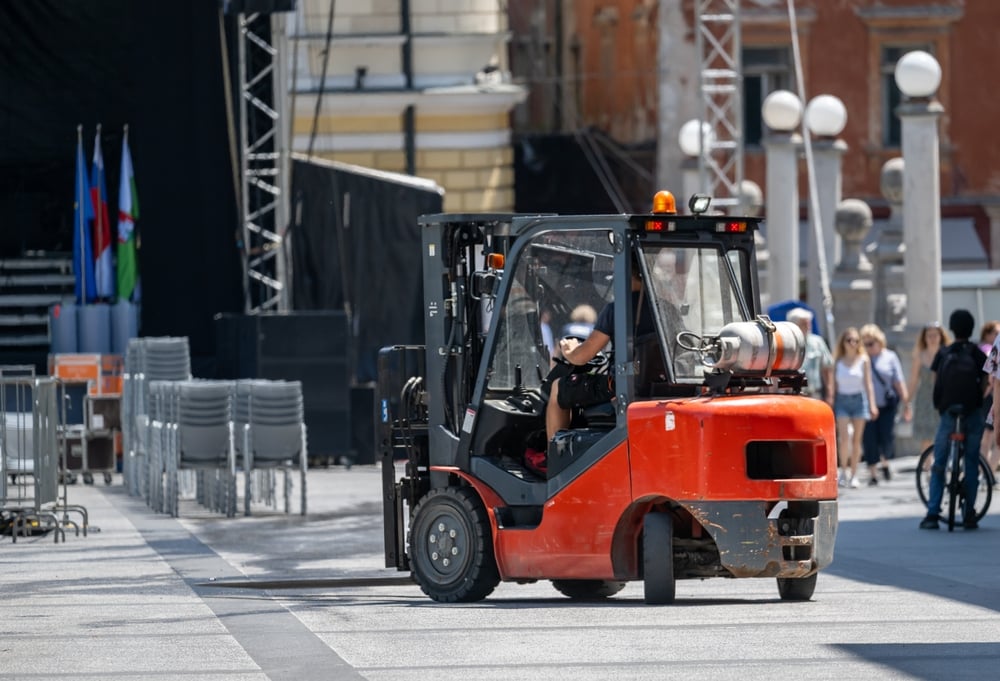
Forklift-Pedestrian Safety: How to Design a Warehouse Where People and Forklifts Coexist
If you’ve ever walked through your warehouse and felt a brief, uncomfortable moment where you weren’t quite sure if the forklift coming around the corner saw you – you’ve already identified the problem this post is about. Forklift pedestrian safety in a warehouse isn’t really about telling your operators to drive carefully. It’s about designing a space where a collision between a 9,000-pound truck and a person becomes almost impossible to begin with.
In this guide, we’ll walk through how to think about your warehouse as a traffic system, the layout and marking decisions that actually move the needle on safety, and the OSHA-aligned best practices that protect your team without slowing your operation down. Let’s dig in.
Why This Matters More Than You Might Think
Pedestrian incidents are the leading cause of forklift fatalities in U.S. workplaces. According to data tracked by the U.S. Bureau of Labor Statistics, forklifts are the source of roughly 70 to 80 work-related deaths and several thousand serious injuries every year, and the majority of fatalities involve workers on foot – not the forklift operators themselves.
That stat is sobering, but here’s the part that matters most: these incidents are overwhelmingly preventable. They don’t happen because forklift operators are reckless or because pedestrians are careless. They happen because the warehouse layout puts people and equipment in the same space at the same time, and eventually, the laws of probability catch up.
The good news is that the same layout decisions that prevent accidents also tend to improve productivity. A warehouse with clear traffic patterns moves faster than one where forklifts and people are constantly negotiating space. Safety and efficiency, in this case, point in the same direction.
A Quick Featured-Snippet Answer
How do you keep pedestrians safe around forklifts in a warehouse? Separate pedestrian and forklift traffic with marked walkways, physical barriers, and designated crosswalks. Use convex mirrors at blind corners, install audible and visual alarms on forklifts, post speed limits, and require high-visibility apparel in active zones. Combine layout improvements with regular operator training and pre-shift inspections. The most effective programs treat warehouse safety as a design problem rather than relying solely on individual caution.
Start with the Map: Audit Your Current Traffic Patterns
Before you buy a single roll of floor tape, walk the warehouse. Bring a clipboard or your phone, and answer these questions:
- Where do forklifts and pedestrians currently share space?
- Where are the blind corners – places where someone can’t see what’s coming?
- Where do people cross forklift routes to get to break rooms, restrooms, time clocks, or other work areas?
- What does the route from the parking lot to each work zone actually look like for someone on foot?
- Where do forklifts have to back up, and who might be behind them?
Most operations have two or three high-risk spots that account for the majority of near-misses. Find those first. They’re usually intersections near loading docks, aisles that lead to break rooms, and the area immediately outside trailer doors where backing trucks meet foot traffic.
If you’re not sure what to look for, it can help to have an outside set of eyes walk through with you. Insurance carriers, equipment dealers, and safety consultants often offer this kind of walk-through, and they tend to spot things that fade into the background for people who see them every day.
Separation: The Single Most Important Principle
The foundational rule of warehouse traffic safety is simple: keep pedestrians and forklifts in separate spaces wherever possible. Everything else flows from that principle.
There are three levels of separation to think about, each with its own trade-offs:
Level One: Floor Markings
This is the entry-level intervention. Painted lines or industrial floor tape define pedestrian walkways, forklift aisles, and “no-go” zones. Yellow is the most common color for walkways, with red or orange used for hazards.
Floor markings are cheap, fast to install, and OSHA-recognized as part of a compliant traffic plan. The catch is that they’re visual reminders, not physical barriers. A floor line won’t stop a forklift that’s swerving, and it won’t stop a pedestrian who’s distracted. They’re a starting point, not a finish line.
Level Two: Physical Barriers
For higher-risk zones, you want something that actually prevents intrusion. Bollards, guardrails, chain barriers, and impact-rated railings all serve this purpose. A worker walking distractedly toward a forklift aisle will be redirected by a guardrail in a way that paint never can.
The U.S. CDC’s NIOSH guidance for workers around forklifts specifically recommends physical separation at intersections and high-traffic areas where the consequences of a collision would be severe. For loading docks, aisles near break rooms, and any area with frequent pedestrian crossings, barriers are worth the investment.
Level Three: Time-Based Separation
Sometimes physical separation isn’t practical – you need forklifts and people in the same space for picking, packing, or loading. In those cases, the next best option is to separate them by time. Run the forklifts before or after pedestrian-heavy work, schedule restock during quiet hours, or use a “spotter” system where one person directs traffic when both are unavoidable.
Time-based separation requires more discipline than physical separation, but for some warehouses it’s the only realistic option in certain zones.
Intersections: Where Most Accidents Happen
If separation is principle number one, intersections are where principle number one breaks down. Most warehouse incidents happen at the points where forklift routes and pedestrian paths cross – and those crossings need engineering, not just paint.
A well-designed intersection includes:
- High-visibility crosswalk striping so pedestrians know exactly where to cross
- Stop signs or yield signs for forklifts at the approach to the crossing
- Convex mirrors at blind corners that let both operators and pedestrians see around the obstruction
- Adequate lighting so visibility doesn’t depend on overhead racks or weather
- Right-of-way rules that everyone knows – typically, pedestrians always have the right of way in marked crossings
Some warehouses go further with active intersection technology: motion-triggered warning lights that activate when a forklift or pedestrian approaches, audible alerts, or even AI-based pedestrian detection systems mounted on the forklifts themselves. These tools are increasingly affordable and they work, but they should layer on top of good design – not substitute for it.
Mirrors, Lighting, and Visibility
Forklift operators have notoriously limited sightlines. Loads block forward vision, the mast obstructs the view to one side, and rearward visibility depends entirely on operators turning their heads. According to a Michigan FACE program information sheet on mobile equipment blind spots, the area immediately behind and to the side of a forklift can be effectively invisible to the operator – a serious problem in any warehouse with active pedestrian traffic.
The fix is to give operators every visibility tool you can:
- Convex mirrors at every blind corner, intersection, and aisle exit
- Bright, even lighting throughout the warehouse, with extra emphasis on traffic zones
- High-visibility apparel for anyone on foot in an active zone – bright vests, reflective stripes, or both
- Strobe lights or beacons mounted on forklifts to make them more noticeable in busy environments
- Audible alarms for both forward motion and reverse, calibrated loud enough to be heard above warehouse noise
These additions are inexpensive relative to the cost of an injury, and they compound – a forklift with both a strobe and a backup alarm is dramatically more noticeable than one with either alone.
Speed: The Invisible Variable
Posted speed limits matter more than most operations realize. A forklift traveling at 8 mph has roughly twice the stopping distance of one traveling at 5 mph, and the difference in impact energy at those speeds is even larger.
Set speed limits by zone. Open aisles can usually support faster travel, while pedestrian-adjacent zones, loading docks, and intersections should be capped at 3 to 5 mph. Post the limits visibly, enforce them consistently, and consider speed-monitoring telematics on newer forklifts that report when an operator exceeds the posted limit.
Speed limits are easy to set, easy to ignore, and disproportionately effective when actually enforced. Most warehouse cultures need an explicit reset at some point – a meeting, a sign campaign, a training refresher – to make speed compliance stick.
The Forklift Itself: Equipment That Helps
The truck you choose can either compound your safety risk or help mitigate it. Modern forklifts offer a range of pedestrian-safety features that older models lack:
- Improved visibility designs with thinner mast profiles and better sightlines around the load
- Blue spot lights that project a moving blue dot on the floor several feet in front of or behind the forklift, giving pedestrians a visual warning before the truck arrives
- Red zone lights that project a wide warning line on either side of the truck
- Pedestrian detection systems using cameras and AI to alert operators when someone enters a danger zone
- Speed-limiting electronics that automatically reduce maximum speed in designated zones
- Quieter electric drivetrains that – while quieter is sometimes worse for pedestrian awareness – pair well with audible warning systems
When you’re evaluating equipment, ask about these features and how they integrate with your existing operation. The right combination of truck-side and warehouse-side safety design dramatically reduces incidents.
For operations with mixed environments or seasonal demands, forklift rentals can be a smart way to bring in newer, better-equipped trucks for peak periods without committing to a long-term purchase.
Training Is Part of the Design
You can’t design your way out of human error entirely. The best layout in the world still requires operators who understand the rules, pedestrians who follow the markings, and a culture that treats safety as a shared responsibility.
Effective forklift training covers more than just how to drive the truck. It includes:
- How to scan intersections and approach blind corners safely
- When to stop and re-evaluate before proceeding
- How to communicate with pedestrians using horn signals, hand signals, and eye contact
- What to do when a pedestrian violates the marked walkway rules
- How to perform daily pre-shift inspections that catch mechanical issues before they become safety problems
Pedestrian training matters too. Anyone who works in or visits the warehouse should understand the traffic rules, recognize warning sounds and lights, and know to wait for explicit acknowledgment from a forklift operator before crossing in front of a moving truck.
Maintenance: The Often-Overlooked Safety Layer
A safety-conscious warehouse can still have an incident if the forklift’s brakes, horn, lights, or steering aren’t working properly. Regular forklift repair and maintenance isn’t just about uptime – it’s a safety control.
Daily pre-shift checks should verify that horns, backup alarms, lights, mirrors, and brakes are all functional. Any defect should pull the truck out of service until it’s fixed. The temptation to “just use it for one more shift” is exactly how minor maintenance issues become serious incidents.
Common Mistakes Warehouses Make
A few patterns worth flagging:
Relying only on floor tape. Paint and tape are a starting point. For high-risk zones, you need physical barriers or active controls.
Designing for the operators, not the pedestrians. It’s easy to forget that visitors, delivery drivers, new hires, and office staff don’t know your traffic patterns. Design for the least experienced person who will ever walk through.
Ignoring “casual” pedestrian routes. People take shortcuts. If the official path from the break room to the workstation is 200 feet longer than the path through the forklift aisle, someone will eventually take the shortcut. Design the official path to be the easiest path.
Treating signs and markings as set-and-forget. Floor markings fade. Signs get covered by stored materials. Audit the visibility of your safety infrastructure quarterly and refresh anything that’s degraded.
Underestimating the importance of culture. A warehouse where supervisors visibly follow the rules – including stopping at crosswalks themselves – has dramatically better compliance than one where leadership treats the markings as suggestions for hourly workers only.
Building a Phased Plan
If you’re starting from a warehouse that wasn’t designed for pedestrian safety, you don’t have to fix everything at once. Here’s a reasonable phased approach:
Phase 1 (Week 1): Audit. Identify the two or three highest-risk zones and document them.
Phase 2 (Month 1): Floor markings, mirrors, signage, and high-visibility apparel for all warehouse-floor personnel.
Phase 3 (Quarter 1): Physical barriers at the highest-risk intersections, posted speed limits, and updated operator training.
Phase 4 (Year 1): Equipment upgrades – pedestrian detection systems, blue spot lights, telematics – paired with refreshed training and a measurable safety review.
Each phase compounds the value of the prior ones. You’ll see near-miss reports drop after Phase 2, recordable incidents drop after Phase 3, and culture-level shifts after Phase 4.
Wrapping It Up
Forklift pedestrian safety isn’t a problem you solve once and forget. It’s an ongoing combination of layout, equipment, training, and culture – and the operations that take it seriously generally find that their productivity improves alongside their safety record.
The good news is that none of this requires a complete warehouse overhaul. Start with the audit, fix the highest-risk zones first, and build from there. If you want help evaluating your current setup – whether that means assessing your equipment, your training program, or your layout – reach out to our team. We’ve walked enough warehouses across the Southeast and Midwest to spot the patterns quickly, and we’re happy to help you make yours safer without the sales pitch.
Frequently Asked Questions
What’s the most effective single change to improve forklift pedestrian safety?
Physical separation between pedestrian walkways and forklift traffic, particularly at high-risk intersections, is the highest-impact single change for most warehouses. Floor markings are a useful starting point, but they don’t physically prevent a collision – guardrails, bollards, and impact-rated barriers do. For warehouses that can only invest in one improvement, separating people from equipment at the top two or three highest-traffic intersections typically delivers the biggest reduction in near-misses and recordable incidents. Pair that with mirrors at blind corners for even better results.
What does OSHA require for warehouse traffic safety?
Federal workplace safety regulations require that warehouses provide a workplace free from recognized hazards. For forklift operations specifically, this includes operator training and certification, daily equipment inspections, posted capacity and operating information, and reasonable measures to protect both operators and pedestrians. While OSHA doesn’t prescribe exact floor-marking colors or barrier types, inspectors look for evidence of a thoughtful traffic plan – marked walkways, controlled intersections, and protections at high-risk areas. Compliance failures in forklift operations are among the most frequently cited workplace violations each year.
How fast should forklifts travel inside a warehouse?
Most safety experts recommend a maximum of 5 mph in open warehouse aisles and 3 mph in pedestrian zones, loading docks, and intersections. Some manufacturers recommend even lower speeds for areas with high foot traffic. Speed should always be reduced when visibility is limited, the load is bulky or heavy, or pedestrians are nearby. Many modern forklifts include electronic speed limiters that can be configured by zone, automatically slowing the truck in marked pedestrian areas. Posted speed limits should be visible, consistent, and enforced – unenforced limits provide minimal safety benefit.
Do pedestrians always have the right of way around forklifts?
Yes, as a general rule pedestrians have the right of way in any marked crosswalk or pedestrian walkway. Forklift operators are required to slow down, stop if necessary, and yield to pedestrians at crossings. That said, “right of way” doesn’t mean pedestrians can step blindly into forklift paths. Good pedestrian practice includes making eye contact with the operator, waiting for an explicit acknowledgment before crossing, staying alert to backing trucks, and avoiding earbuds or distractions in active warehouse zones. Safety in shared spaces requires awareness from everyone, regardless of who has formal right of way.
What pedestrian safety equipment is worth the investment?
Mirrors at blind corners, audible alarms and strobe lights on forklifts, and high-visibility vests for warehouse-floor personnel are the highest-ROI investments for most operations – relatively low cost with measurable safety impact. Beyond those basics, blue spot lights on forklifts (which project a moving blue dot ahead of or behind the truck) are increasingly affordable and effective. For larger operations or higher-risk environments, AI-based pedestrian detection systems mounted on forklifts can pay for themselves quickly by preventing even a single serious incident. Pair equipment with consistent training to get the full benefit.
Share This!
Subscribe to Our Newsletter
"*" indicates required fields