The 5-Minute Forklift Inspection That Prevents Most Breakdowns and Citations
If your operators are skipping the daily forklift walk-around because it “takes too long” or “nothing’s ever wrong” – you’ve got a problem brewing that’s bigger than you might realize. A proper forklift daily inspection takes about five minutes, catches the small issues before they become expensive ones, and is a federal requirement for any operation running powered industrial trucks. Skipping it doesn’t just risk a citation; it risks a breakdown mid-shift, an injury, and a workers’ comp claim that’ll cost you more than years of preventive maintenance combined.
In this guide, we’ll walk through exactly what a good pre-shift inspection looks like, why it pays for itself many times over, and how to build a culture where operators actually do the check instead of just signing the form. No fluff – just the practical version.
Why Daily Inspections Matter More Than People Realize
Here’s the case in three quick points:
It’s the law. Federal workplace safety regulations require that every forklift be examined before it’s placed in service, and after each shift if the truck runs around the clock. There’s no exception for “we just inspected it yesterday” or “it’s been working fine.” The requirement is daily, period.
It catches problems cheap. A loose hose clamp is a 30-second fix during inspection. The same loose hose clamp at 2 PM under load is a hydraulic spill, a downed truck, and a half-day of lost productivity. The inspection is one of the highest-ROI activities in your warehouse.
It protects you legally. If something goes wrong and you can demonstrate a documented inspection program, your liability exposure drops dramatically. If you can’t, you’re on the defensive from day one.
This isn’t theoretical. Powered industrial truck violations consistently rank among the most-cited workplace safety standards every year, and “failure to inspect” is one of the most common specific citations within that category. Operations that skip the inspection aren’t quietly getting away with it – they’re rolling the dice every shift.
A Quick Featured-Snippet Answer
What should be on a forklift daily inspection checklist? A complete pre-shift forklift inspection covers the truck’s tires, forks, mast and chains, hydraulic hoses, fluid levels, battery or fuel system, lights, horn, backup alarm, seatbelt, brakes, steering, and operator controls. The inspection should be performed before the truck is placed in service each shift, take about 5 minutes, and document any defects. Any forklift with a defect that affects safety must be removed from service until repairs are completed.
The Two Parts of a Proper Inspection
A daily inspection has two phases. Skip either one and you’ve missed half the value.
Phase 1: The Visual Walk-Around (Key Off)
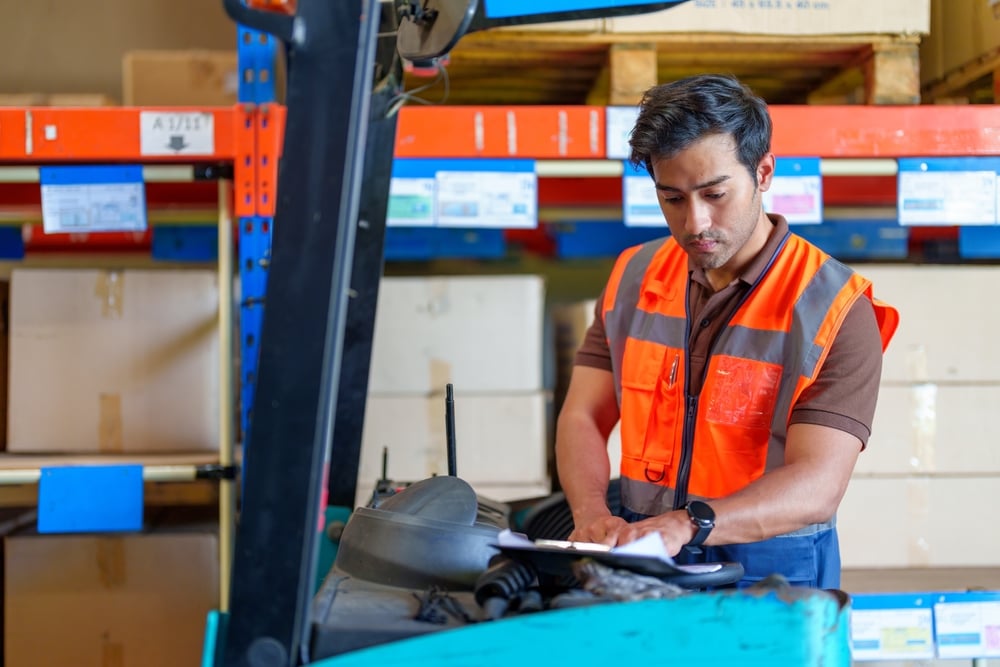
This is the “look at it” phase. Park the forklift on level ground, turn off the key, set the parking brake, and walk around the whole truck before you even sit down.
Look for fluid on the floor underneath the truck – oil, hydraulic fluid, coolant, battery acid. Even a small puddle is a signal. Look at the tires for chunking, flat spots, cracks, or embedded debris. Check the forks for cracks, bends, or wear at the heel where they meet the carriage. Look at the mast chains for stretch, kinks, or rust, and the mast rails for damage or excessive wear.
Open the operator’s compartment. Is the seat secure? Is the seatbelt functional and free of cuts or fraying? Are the pedals clean and free of debris? Is the overhead guard solid, with no cracks or modifications?
Pop the hood (or open the battery compartment for an electric truck). Check fluid levels – engine oil, hydraulic fluid, coolant, and washer fluid for internal combustion forklifts; electrolyte and connections for lead-acid batteries. Look at the battery cables for corrosion or fraying. For propane forklifts, check the tank mounting and look for any signs of leakage around the fittings.
This phase should take two to three minutes. It catches a lot.
Phase 2: The Operational Check (Key On)
Now climb in, buckle up, and start the truck. With the engine or motor running, test every system:
- Horn – does it work? Loud enough to be heard above warehouse noise?
- Lights – headlights, working lights, warning strobes if equipped?
- Backup alarm – does it sound the moment you put it in reverse?
- Brakes – service brakes stop the truck promptly without pulling to one side; parking brake holds on a slight incline
- Steering – smooth, responsive, no excessive play in either direction
- Hydraulics – lift, lower, tilt, and any attachments – all smooth, no jerking, no unusual noises
- Mast operation – full range of motion without binding or noise
- Gauges and warning lights – anything illuminated that shouldn’t be?
- Operator presence sensor – if you stand up from the seat, does the truck cut power as designed?
This phase takes another two to three minutes. If anything fails, the truck comes out of service. Period.
Why “It Looked Fine” Isn’t an Inspection
Here’s where a lot of operations go off the rails. The operator hops in, fires up the truck, drives it once around the loading area, decides it “feels fine,” and gets to work. They check the box on the form and call it done.
That’s not an inspection. That’s a vibe check.
A real inspection follows the same sequence every time, hits every required item, and produces documentation. The reason isn’t bureaucracy – it’s that human memory is unreliable. Operators who “inspect by feel” routinely miss issues that a structured walk-around catches: a small hydraulic leak under the truck, a chain that’s stretched 3% past tolerance, a worn fork heel that’s about to fail. These things don’t announce themselves. They’re found only by people who look for them deliberately.
This is also where consistent forklift training pays off. Operators trained to follow a structured inspection process – and re-trained when they start cutting corners – catch problems weeks earlier than operators left to figure it out on their own.
What OSHA Actually Requires (Versus What People Assume)
There’s some confusion floating around about written checklists. Federal regulations require the inspection itself, but interestingly, the agency has clarified through interpretation letters that the inspection doesn’t have to be written down to satisfy the regulation. According to an OSHA interpretation letter on pre-operation forklift examinations, the standard requires powered industrial trucks to be examined before being placed in service, but the regulation doesn’t specifically mandate a written record.
That said – and this is important – most safety professionals and insurance carriers strongly recommend written documentation anyway. Here’s why:
- It standardizes what gets inspected, so nothing gets missed
- It creates a paper trail proving you actually did the inspection
- It gives you historical data to spot patterns (e.g., “this truck has had a hydraulic leak written up four times in the last month”)
- It protects you if there’s ever an incident and you need to demonstrate compliance
So while you’re not legally required to write it down, you absolutely should. The benefits are massive and the cost is essentially zero.
What to Do When You Find a Problem
Here’s where a lot of operations fold. Operator notices a problem during inspection, but the truck is needed for the shift, so they go ahead and use it anyway, planning to “fix it later.”
That’s the exact scenario that turns a small issue into a major incident. The rule is simple: if a defect affects the truck’s safe operation, the truck comes out of service until it’s repaired. No exceptions, no “we’ll baby it through this shift,” no shortcuts.
What “out of service” looks like in practice:
- Tag it. Use a brightly colored “Out of Service” or “Do Not Operate” tag on the steering wheel or key switch.
- Remove the key. If it’s not running, it’s not getting accidentally used.
- Report it. Notify the supervisor and the maintenance team immediately, with specifics about what’s wrong.
- Document it. Note the defect on the inspection form and the date/time the truck was taken out of service.
- Repair, don’t patch. Get it fixed properly by qualified personnel before returning it to service.
For most common defects, the right approach is to get the truck to a qualified technician quickly – either in-house if you have that capability, or through a service like our forklift repair team for issues beyond what a daily operator can address. Stocking common wear items as part of your forklift parts inventory ahead of time can turn a half-day downtime into a 20-minute fix.
Building a Culture Where Inspections Actually Happen
Having a checklist is easy. Getting operators to use it diligently every shift is the hard part. Here’s what works:
Make it the first thing. The inspection happens before the truck moves, not after. Operators who try to “inspect while working” miss things and create a culture where the inspection is optional.
Don’t punish honesty. If an operator writes up a problem and the response is “ugh, now we have to deal with this,” they’ll stop writing up problems. The right response is “good catch, let’s fix it.” Reward the behavior you want.
Audit the documentation. Periodically pull inspection forms and walk the trucks yourself. If a form shows everything was perfect but the truck has a slow hydraulic leak that’s clearly been there a while, you’ve got a culture problem to address – not a maintenance problem.
Train, re-train, and re-train again. Operators get complacent. New operators inherit bad habits from veterans. Schedule refresher training periodically – not just because it’s required, but because it works.
Connect it to outcomes. When something good happens – a near-miss avoided, a breakdown prevented, downtime reduced – call it out. When something bad happens because an inspection was skipped, talk about it openly. Make the connection visible.
How Inspections Connect to Operating Costs
The numbers on this are interesting. Operations with rigorous inspection programs typically see:
- Lower repair costs because problems are caught early, when they’re cheap to fix
- Less downtime because breakdowns are rarer and more predictable
- Lower workers’ comp premiums because injury rates drop
- Better resale value when it’s time to upgrade the fleet
- Fewer citations during workplace safety inspections
The Bureau of Labor Statistics tracks workplace injury data through its Survey of Occupational Injuries and Illnesses, and the trend is consistent year over year: operations that invest in equipment maintenance and operator training have meaningfully lower injury rates than those that don’t. The five minutes per truck per shift is some of the cheapest insurance you can buy.
For operations evaluating whether to invest in new equipment, this is also worth considering when you’re comparing forklift options. Newer trucks generally have better diagnostic systems, fewer leak points, and more reliable electronics – making the daily inspection both faster and more effective.
Type-Specific Inspection Notes
Not all forklifts inspect the same. A few notes by type:
Electric forklifts – Spend extra time on the battery. Check electrolyte levels (for lead-acid), look for corrosion at terminals, verify the battery is properly secured, and inspect cables and connectors. Per OSHA’s eTool on pre-operation forklift checks, always wear personal protective equipment when handling battery components, including face shield, rubber apron, and rubber gloves.
Propane forklifts – Inspect the LP tank for proper mounting and any signs of damage or leakage at fittings. Use leak-detection solution if you suspect a leak – never an open flame. Verify the tank is properly secured.
Diesel and gasoline forklifts – Check engine oil, coolant, and fuel levels. Look for any fuel leaks around the tank, fuel lines, and injectors. Check the air filter and exhaust system.
Outdoor and rough terrain forklifts – Add an inspection of tire chains (if used in winter), outrigger function (if equipped), and cab visibility through any cab enclosure or windshield. Mud, snow, and debris should be cleared from the operator’s compartment and step before getting in.
Older trucks – Pay extra attention to fluid leaks, electrical components, and structural welds. Trucks that are 10+ years old can still work fine, but they need more diligent inspection than newer equipment.
Wrapping It Up
A daily forklift inspection is one of those small, repetitive practices that feels unimportant on any given day but adds up to enormous value over time. Five minutes per truck per shift, done consistently, prevents most of the breakdowns, injuries, and citations that plague warehouses that skip it.
If you want help building a better inspection program – whether that means operator training, a service relationship for the issues operators flag, or just a fresh set of eyes on your current process – reach out to our team. We’ve helped operations across the Southeast and Midwest tighten up their inspection programs without slowing down their operations, and we’re happy to do the same for you.
Frequently Asked Questions
How often does a forklift need to be inspected?
Federal workplace safety regulations require that every forklift be inspected before it’s placed in service each shift. Trucks used on a round-the-clock basis must be inspected after each shift. This is a hard rule, not a guideline – daily, every shift, no exceptions. Some operations also build in mid-shift checks for trucks running in particularly demanding conditions (heat, dust, heavy loads). The minimum is daily; more frequent is generally better, especially for older equipment or high-duty-cycle operations.
Who is qualified to perform a daily forklift inspection?
The daily pre-shift inspection is performed by the operator before each shift. The operator must be a trained, certified, and authorized forklift operator – federal regulations explicitly require that only trained personnel operate (and therefore inspect) powered industrial trucks. If a defect is found, repairs must be performed by qualified maintenance personnel, not by the operator. The line between “inspection” and “repair” matters: operators identify problems; technicians fix them. Don’t blur that distinction, and don’t let operators try to repair issues beyond minor adjustments.
Does OSHA require a written forklift inspection checklist?
The regulation itself doesn’t explicitly require a written record – federal guidance has clarified that the requirement is for the inspection to happen, not specifically for it to be documented. However, written documentation is strongly recommended by safety professionals, insurance carriers, and most experienced operators. A written checklist standardizes the inspection, prevents items from being skipped, creates an audit trail, and provides legal protection in the event of an incident. The cost of using a written form is essentially zero, and the benefits are significant. Almost every well-run operation uses one.
What should I do if my operator finds a problem during inspection?
Remove the truck from service immediately if the defect affects safe operation. Tag the truck with a clearly visible “Out of Service” or “Do Not Operate” tag, remove the key, and notify the supervisor and maintenance team. Document the defect on the inspection form. Have the issue repaired by qualified personnel before returning the truck to service. Do not allow operators to use a defective truck “just for this shift” – that’s how minor issues become serious incidents. The five minutes of downtime now is dramatically cheaper than the alternative.
How long should a daily forklift inspection take?
A thorough daily inspection takes 5 to 10 minutes for an experienced operator. New operators may need up to 15 minutes initially as they learn the process. The visual walk-around (key off) typically takes 2 to 3 minutes, and the operational checks (key on) take another 2 to 3 minutes. If your operators are completing inspections in 60 seconds, the inspection isn’t happening – they’re skimming the form. If they’re taking 30 minutes, they’re not yet familiar with the process and need additional training. The right pace is steady, deliberate, and consistent.
Share This!
Subscribe to Our Newsletter
"*" indicates required fields