
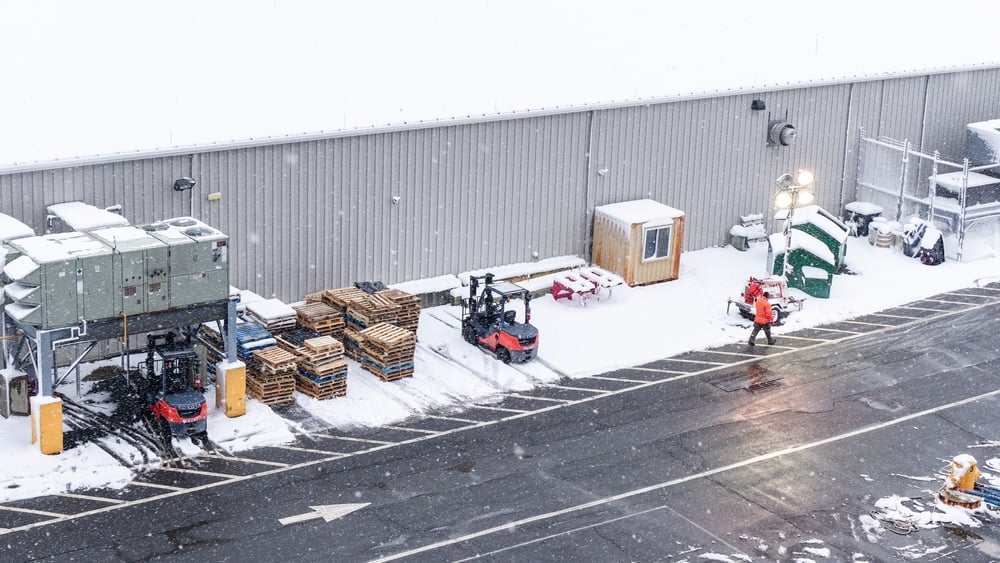
Forklift Cold Weather Maintenance: Why Your Fleet Needs Winter Prep (Even in Tennessee and Texas)
If you operate forklifts anywhere that sees a real winter – and that includes most of the southeastern and central U.S., not just the Upper Midwest – your fleet is going to behave differently when the temperature drops. Hydraulic fluid thickens. Batteries lose capacity. Tires lose pressure. Diesel engines crank slower. Seals that were fine in October start weeping in January. And the freeze-thaw cycles that hit Nashville and Fort Worth a few weekends each winter create their own special problems that fleets in cold-stable climates don’t deal with.
Solid forklift cold weather maintenance isn’t optional – it’s the difference between a productive winter and a string of expensive breakdowns. In this guide, we’ll walk through what cold actually does to your equipment, what to check and when, and how to plan ahead so you’re not learning the hard way on the morning of the first hard freeze.
The Quick Answer: What Forklift Cold Weather Prep Should Cover
Forklift cold weather maintenance should address six core systems before temperatures drop: the battery (charge levels and warming), the hydraulic system (winter-grade fluid and longer warm-up), the engine (winter oil, glow plugs, antifreeze), tires (PSI checks and traction), exposed components (seals, hoses, electrical connections), and operator-related items (lighting, heated cabs, slip prevention). Lead-acid batteries can lose 20-35% of their capacity at freezing temperatures, hydraulic fluid thickens significantly below 40°F, and tire pressure drops about 1-2 PSI for every 10°F decrease in air temperature.
That’s the executive summary. Now let’s dig into what’s actually happening inside the equipment and what to do about it.
Why Cold Hits Forklifts So Hard
A forklift is an unusually unforgiving piece of equipment when it comes to temperature changes. Unlike a car, which is built with consumer comfort in mind, most forklifts spend their lives in environments designed for predictability – a 65°F warehouse, a covered loading dock, a fairly stable temperature range. When that stability disappears, all kinds of small problems suddenly compound.
There are three core reasons cold weather hits forklifts particularly hard:
- Fluid viscosity changes. Hydraulic oil, engine oil, transmission fluid, and gear lube all thicken as they cool. Thicker fluid means more strain on pumps, slower response from cylinders, and more wear on every moving part.
- Battery chemistry slows down. The electrochemical reactions that produce electricity in any battery slow down as temperatures drop. Lead-acid batteries are particularly affected.
- Freeze-thaw cycles cause condensation damage. When a forklift moves between a heated indoor environment and a cold outdoor one, moisture condenses on electrical components, inside hydraulic systems, and in fuel tanks. That moisture freezes, thaws, and corrodes – slowly and expensively.
There’s also a human safety layer. As OSHA notes in its Winter Weather preparedness guidance, employers have a general-duty obligation to protect workers from cold-stress hazards. That obligation extends to making sure equipment is safe to operate in cold conditions – a lift that won’t brake reliably or has a frozen mast isn’t just inconvenient, it’s a safety issue.
How Cold Affects Each Major System
Batteries: The Single Biggest Cold-Weather Problem
If you only do one thing to prep your forklifts for winter, focus on the batteries. Both lead-acid and lithium-ion batteries lose capacity as temperatures drop, and the effect is significant:
- Lead-acid batteries can lose 20-35% of their available capacity at freezing temperatures, with some sources reporting losses up to 50% in extreme cold. A battery that gives you a full shift in summer might give you five or six hours in January.
- Lithium-ion batteries handle cold better than lead-acid, but they’re not immune. Below about -4°F, lithium-ion performance can drop to 50-70% of room-temperature capacity, and most manufacturers recommend against charging lithium-ion batteries below 32°F because it can cause permanent damage.
What to do:
- Keep batteries charged. A fully charged battery is more cold-resistant than a partially charged one. Avoid leaving batteries sitting at low charge in cold conditions – that’s when they take damage.
- Charge in warm areas. Move chargers and battery rooms into the warmest available space, away from exterior walls and dock doors.
- Switch to winter charge profiles if your charger supports them. Some smart chargers have cold-weather modes that adjust charging current.
- Consider battery blankets or heated battery compartments for outdoor or yard trucks.
- Plan for shorter runtime. If you normally run one battery per shift, you may need a backup ready to swap in mid-shift during cold weeks.
If your current batteries are aging or you’re considering an upgrade, our industrial batteries and chargers team can walk you through the lead-acid vs. lithium-ion decision in the context of how cold your operation actually gets.
Hydraulic Systems: The Slow Mast Problem
The hydraulic system is what powers your mast, your steering, and (depending on the model) your brakes. When hydraulic fluid thickens in the cold, every one of those functions slows down – and the strain on the pump goes up. You’ll hear it before you see it: pumps sounding labored, masts moving like they’re carrying a phantom load, hoses that feel stiff instead of supple.
The fix is a combination of three things:
- Use the correct seasonal hydraulic fluid. Most manufacturers specify a multi-grade or low-viscosity fluid for cold operation. Check your operator’s manual or the data plate.
- Extend the warm-up cycle. A diesel or LPG forklift coming out of overnight cold storage should idle for 5-10 minutes before being put to work, with the mast cycled (raised and lowered) a few times at low load to circulate warm fluid through the system. This is one of the most frequently skipped steps in cold-weather operation.
- Inspect hoses and seals before the first cold snap. A seal that was barely holding in October will likely fail when the fluid pressure spikes against thickened oil. Replace anything weeping or visibly cracked. Our forklift repair team handles pre-winter inspections specifically to catch these issues before they turn into mid-shift failures.
Internal Combustion Engines: Starting Strain
Diesel and propane forklifts have their own cold-weather quirks.
- Diesels struggle to start in cold weather because diesel fuel itself can gel below about 15°F. Engine oil thickens, batteries lose cranking power, and glow plugs (if equipped) work harder to heat the combustion chamber. Solutions: winter-grade diesel fuel or a diesel fuel additive, an engine block heater for trucks that sit outside overnight, and a fresh check on glow plugs and starter batteries before winter.
- LPG (propane) trucks have a unique cold-weather problem: propane vaporization slows down significantly in the cold. The liquid propane in the tank needs to vaporize before it can enter the engine, and below about 20°F, that vaporization gets sluggish. Symptoms include hard starting, rough idle, and stalling under load. The fixes here include warming the tank (don’t leave LPG cylinders outside overnight if you can avoid it), rotating tanks more frequently, and inspecting the regulator and vaporizer for ice buildup.
- All IC engines benefit from a switch to winter-weight oil (typically 5W-30 or 10W-30 instead of straight 30W), an antifreeze check (50/50 mix down to about -34°F protection), and a fresh battery check on the starter battery itself.
Tires: The Pressure and Traction Problem
Tire pressure drops about 1 to 2 PSI for every 10°F decrease in ambient temperature. That sounds small, but if your tires were set to spec at 75°F and you’re now operating at 25°F, you’ve lost 5-10 PSI – enough to affect stability, handling, and fuel efficiency.
Cold also makes pneumatic tires stiffer and less compliant, which means worse traction on cold concrete and almost no traction on ice or compacted snow. Cushion tires (solid rubber) hold up better in cold but are still slipperier than they are in summer.
What to do:
- Check tire pressure weekly during cold months on pneumatic tires, and reset to manufacturer spec.
- Inspect for cracking in the sidewalls and tread. Rubber gets more brittle in the cold, and small cracks become big ones fast.
- Plan traction interventions for icy areas: salt or sand the dock approach, install drip catches under exterior doors, and consider studded or specialty cold-weather tires for trucks that work outside year-round.
- Slow operators down. Stopping distances increase noticeably on cold surfaces, especially when frost forms on concrete overnight.
Seals, Hoses, and Electrical: The Quiet Failures
The components most likely to fail in the cold without warning are the ones nobody thinks about until they break: rubber seals, hydraulic hoses, electrical connectors, and exposed wiring.
- Rubber gets brittle in the cold. Seals and gaskets that were fine in October can crack and leak when the temperature drops, especially if they were already aging.
- Hydraulic hoses can develop hairline cracks that don’t show until they’re under pressure.
- Electrical connectors can corrode from condensation, leading to intermittent faults that are notoriously hard to diagnose.
- Battery terminal connections oxidize faster in cold, damp environments, which compounds the battery capacity problem.
Pre-winter inspection of all of these is straightforward but tedious – and exactly the kind of thing a planned-maintenance visit is built for. Stocking common replacement parts in your forklift parts inventory before winter is a small investment that pays off the first time a hose lets go at 7 a.m. on a Monday.
Freeze-Thaw Cycles: The Southern Forklift Problem
Here’s the part that catches operators in Tennessee and Texas off guard. Fleets that operate in consistently cold climates have it relatively easier in one specific way: their forklifts stay cold. Equipment that’s continuously at 20°F doesn’t deal with condensation the same way equipment that swings from 65°F indoors to 28°F outdoors and back several times a shift does.
Every time a forklift moves from a heated warehouse to a cold loading dock, warm moist air condenses on cold surfaces. That moisture finds its way into electrical components, fuel systems, hydraulic reservoirs, and any small crack or gap in the truck’s enclosure. When the truck warms back up, some of that moisture evaporates – but not all of it. Over a few weeks of repeated cycles, you end up with corroded contacts, water in your fuel, and condensation in your hydraulic system.
This is also why NOAA’s wind chill data matters even for indoor operations – a 35°F day with 25 mph wind at an exposed dock creates a wind chill near 24°F at the dock face, which means anything cycling through that dock is getting hit with real cold, even if the outdoor air temperature reading sounds mild.
The mitigations for freeze-thaw issues are mostly operational:
- Minimize unnecessary cycling. Plan loading runs in batches rather than constant in-and-out trips.
- Install dock seals and air curtains to reduce the temperature differential at exterior openings.
- Wipe down or dry equipment that comes in from outside before parking it overnight.
- Use desiccant breathers on hydraulic reservoirs to reduce moisture intrusion.
- Schedule extra battery and electrical checks during freeze-thaw weeks specifically.
A Pre-Winter Forklift Maintenance Checklist
Most of the items above can be rolled into a single pre-winter PM visit, ideally completed in late October or early November before the first hard cold snap. Here’s a working checklist:
- Replace engine oil with winter-grade weight (if IC truck)
- Check and top off antifreeze; verify protection to at least -20°F
- Inspect and test glow plugs and starter batteries (diesel)
- Check propane regulator and vaporizer for ice/wear (LPG)
- Switch to winter-grade hydraulic fluid if specified
- Inspect all hydraulic hoses for cracking or weeping
- Replace any aged seals or gaskets
- Service forklift batteries: equalize charge, check water levels (lead-acid), clean terminals
- Move battery chargers to warmest available indoor location
- Reset tire pressure to spec
- Inspect tires for cracking, wear, and tread depth
- Test all lights and warning beacons; consider LED upgrades
- Verify horn, backup alarm, and operator restraints work in cold
- Check cab heater, defroster, and windshield wipers (if equipped)
- Lubricate mast rollers, chains, and pivot points with cold-weather grease
- Inspect overhead guards and load backrests for stress cracks
- Stock common replacement parts: hydraulic hoses, fuses, filters, belts
Operator Considerations: People Get Cold Too
Equipment is half the equation; operators are the other half. Cold operators make more mistakes, take longer to react, and are more likely to skip pre-shift inspections to get out of the wind. The NIOSH cold-stress guidance is clear that even temperatures in the 40s can create cold-stress conditions when combined with wind or wet conditions – and forklift operators working at exterior docks or in yard operations are exposed to both.
Practical steps:
- Provide proper PPE: insulated gloves that still allow grip on controls, high-visibility cold-weather coats, insulated waterproof footwear with good tread.
- Schedule warm-up breaks for operators working in cold zones, particularly during wind chill events.
- Make pre-shift inspections genuinely possible by allowing time and providing a heated area to fill out the inspection log.
- Train operators on cold-specific hazards – different stopping distances, slower hydraulic response, reduced battery runtime, and the signs of cold stress in themselves and coworkers.
Conclusion: Plan Before the First Cold Snap
Cold weather doesn’t sneak up on anyone, but cold-weather failures do. By the time you notice the symptoms – slow masts, weak batteries, hard starts, leaking hoses – you’ve already had at least one bad shift and probably a couple of unplanned downtime hours.
The fix is straightforward: get ahead of it. Do the inspection in October, switch the fluids before Thanksgiving, train the operators, and stock the parts. The investment is small compared to the cost of even a single day of fleet downtime in the middle of a busy December.
If you’d like a hand putting together a pre-winter inspection and prep plan for your fleet, that’s what we do. Reach out through our contact page and we’ll set up a visit at any of our Nashville, Cookeville, Fort Worth, or Indianapolis locations to walk through what your specific lifts need before the cold actually arrives.
Frequently Asked Questions
At what temperature should I start worrying about my forklift’s cold-weather performance?
Performance issues typically start appearing below about 50°F and become significant below 32°F. Lead-acid batteries begin losing capacity noticeably around 40°F, hydraulic fluid starts thickening below 40°F, and tire pressure drops continuously as temperatures fall. Diesel fuel can begin gelling around 15°F, and lithium-ion batteries shouldn’t be charged below 32°F. Even fleets in milder southern climates should have a cold-weather prep plan in place once forecasts show overnight lows near or below freezing, since that’s when the freeze-thaw cycles begin.
How much does cold weather actually reduce forklift battery life?
It depends on the battery type and temperature, but the effect is significant. Lead-acid forklift batteries can lose 20-35% of their available capacity at freezing temperatures, with some sources reporting losses up to 50% in extreme cold. That means a battery that runs an 8-hour shift in summer might run 5-6 hours in January. Lithium-ion batteries handle cold better but still lose 30-50% of capacity in extreme cold. The good news is that cold-weather capacity loss is temporary – the battery returns to normal performance when temperatures rise – but repeated deep discharges in the cold can permanently shorten battery life.
Do electric forklifts need cold-weather prep, or is it just IC trucks?
Both need prep, but the issues are different. Electric forklifts have the biggest cold-weather problem in the battery itself – capacity loss, slower charging, and the need to keep the battery in a warm space. Hydraulic systems and tires need the same attention on electric trucks as on IC trucks. What electric forklifts don’t need is the engine-specific prep: no winter oil, no antifreeze, no glow plugs, no propane vaporization issues. Overall, electric trucks are often easier to manage in the cold than diesel or propane, especially when paired with lithium-ion batteries – but the battery management piece becomes more critical, not less.
Should I store my forklifts indoors during winter?
Whenever possible, yes. Indoor storage solves many cold-weather problems at once: batteries stay warmer and hold capacity, hydraulic fluid doesn’t thicken as much overnight, fuel stays liquid (for diesel), condensation is reduced, and tires don’t go through extreme pressure swings. If indoor storage isn’t possible, use heavy-duty weatherproof covers, engine block heaters for IC trucks, battery blankets for electric trucks, and consider a small dedicated equipment shed for the highest-value lifts in your fleet. The cost of a covered storage area is typically much less than the cost of a single major cold-weather failure.
How often should I do cold-weather maintenance checks during winter?
Daily pre-shift inspections should continue year-round, but in cold months they need to include a few extra items: tire pressure check, visual inspection of hydraulic hoses for new cracks, verification that lights and warning beacons are functioning, and a check of the cab heater and defroster (if equipped). Weekly, do a more thorough visual on seals, mast lubrication, and battery condition. Monthly during winter, have a technician check fluid levels and condition, inspect for corrosion on electrical connections, and verify charger performance. Most operations find that a planned-maintenance visit every 30-60 days through the winter prevents the bulk of unplanned breakdowns.
Share This!
Subscribe to Our Newsletter
"*" indicates required fields